



Discover
Researchers Reveal the Secrete of Nonrandom DNA Seg-regation in Human Cells
Systemic Lupus Erythematosus (SLE) is a complex, chronic autoimmune disease characterized by the production of a wide array of autoantibodies that attack multiple organ systems. This leads to diverse clinical manifestations and a relapsing-remitting course, severely impacting patients' quality of life. Although therapeutic options have advanced, a subset of patients responds poorly to conventional immunosuppressive therapies, developing refractory Systemic Lupus Erythematosus (rSLE), which urgently requires innovative treatment strategies. In recent years, Chimeric Antigen Receptor (CAR) T-cell therapy has achieved revolutionary breakthroughs in the treatment of hematological malignancies, and its potential application in autoimmune diseases has garnered significant attention.
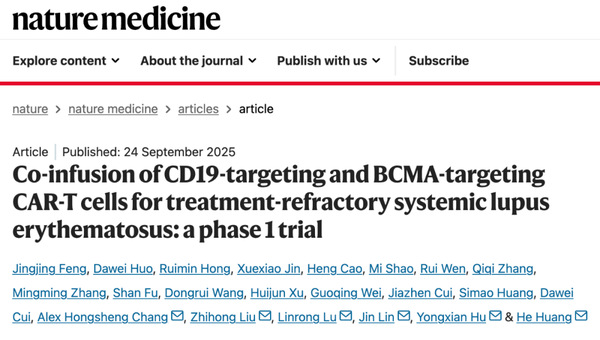
On September 24, 2025, a collaborative team including Professor HUANG He and Professor HU Yongxian from The First Affiliated Hospital, Zhejiang University School of Medicine (FAHZU)/Liangzhu Laboratory, alongside Academician LIU Zhihong from Nanjing University School of Medicine/Liangzhu Laboratory, Professor LU Linrong from Zhejiang University School of Medicine/Liangzhu Laboratory, and Professor LIN Jin from FAHZU, published a research paper in the top international medical journal Nature Medicine titled Co-infusion of CD19-targeting and BCMA-targeting CAR-T cells for treatment-refractory systemic lupus erythematosus: a phase 1 trial.
This study represents the largest clinical trial of CAR-T cell therapy for SLE reported to date. For the first time, the team combined single-cell B-cell receptor (BCR) sequencing with antibody expression and purification validation techniques to discover that pathogenic autoantibodies can originate from two types of cells: CD19⁺BCMA⁻ memory B cells and CD19⁻BCMA⁺ long-lived plasma cells. This finding provided a critical theoretical basis for adopting a dual-target combination therapy.
Based on this discovery, the team initiated a Phase 1 clinical trial enrolling 15 patients with refractory SLE. The results showed:
Good Safety Profile: During a median follow-up period of 712 days, no dose-limiting toxicities or treatment-related deaths occurred.
Significant Efficacy: At 12 weeks post-CAR-T cell infusion, 80% (12/15) of patients achieved Lupus Low Disease Activity State (LLDAS). All patients showed sustained improvement in SLE-related symptoms, with a significant decrease in autoantibody levels, normalization of complement levels, and marked improvement in indicators of organ damage such as proteinuria. As of the time of writing, no patients had relapsed.
Mechanism Revealed: Follow-up results demonstrated that the therapy can durably eliminate pathogenic B-cell clones and reconstitute a healthy humoral immune system, achieving an immune system reset.
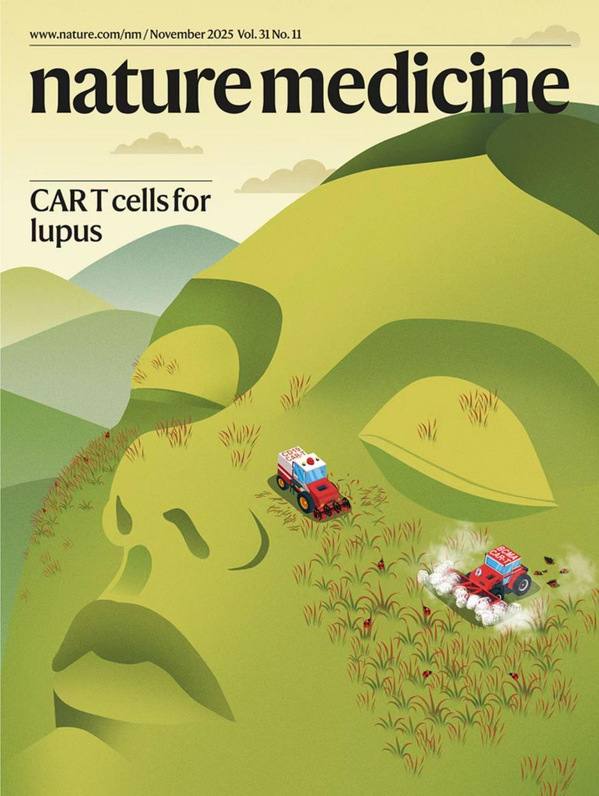
(The cover story of the current issue of Nature Medicine: The image depicts a butterfly-shaped hilly farmland overgrown with weeds, where a tractor and sprayer are clearing the weeds and pests. This vividly symbolizes how the dual-target CAR-T cell therapy precisely eliminates pathogenic B cells and long-lived plasma cells, achieving an immune system reset and a renewal of life.)
Due to its groundbreaking results, the study was selected as the cover article for the November 2025 issue of Nature Medicine. In the same issue, the News & Views section featured a special commentary by renowned international rheumatology and immunology experts Joan T. Merrill and Judith A. James, who highly praised the work.
This study not only clinically validated the safety and efficacy of the co-infusion of CD19-targeting and BCMA-targeting CAR-T cells for treating refractory SLE, but also confirmed through nearly two years of follow-up and single-cell multi-omics analysis that the therapy can completely eradicate pathogenic B-cell clones present before treatment, which did not re-emerge during immune reconstitution. This provides strong molecular evidence for achieving a 'functional cure' for Systemic Lupus Erythematosus and lays a solid theoretical and clinical foundation for future cellular immunotherapies for autoimmune diseases.
This research represents a collaborative endeavor involving investigators from The First Affiliated Hospital, Zhejiang University School of Medicine (FAHZU), Liangzhu Laboratory, Nanjing University School of Medicine, and other participating institutions. Attending Physician FENG Jingjing, Distinguished Researcher HUO Dawei, and Attending Physician HONG Ruimin from FAHZU; Assistant Researcher JIN Xuexiao from Sir Run Run Shaw Hospital, Zhejiang University School of Medicine; and Chief Physician CAO Heng, Resident Physician SHAO Mi, and Ph.D. Candidate WEN Rui from FAHZU are recognized as co-first authors for their equivalent contributions to this paper. The principal corresponding authors for this publication are Professor HUANG He, Professor HU Yongxian, Academician LIU Zhihong, Professor LU Linrong, and Professor LIN Jin.
Source: The First Affiliated Hospital, Zhejiang University School of Medicine (FAHZU)
Editor: HAN Xiao, GAO Wanlu