
From 21 to 23, November, the Orthopedics and Spine Surgery Team led by HU Qingfeng, Director of the Department of Orthopedics and Spine Surgery at the Fourth Affiliated Hospital, Zhejiang University School of Medicine (ZJU4H), was invited to visit Nepal to perform live surgical demonstrations and academic exchanges. The team successfully performed cervical Unilateral Biportal Endoscopy (UBE) surgery and lumbar UBE surgery with the preservation of the ligamentum flavum, thereby filling a local technical gap and offering new minimally invasive treatment options related to complex spinal disorders in Nepal.
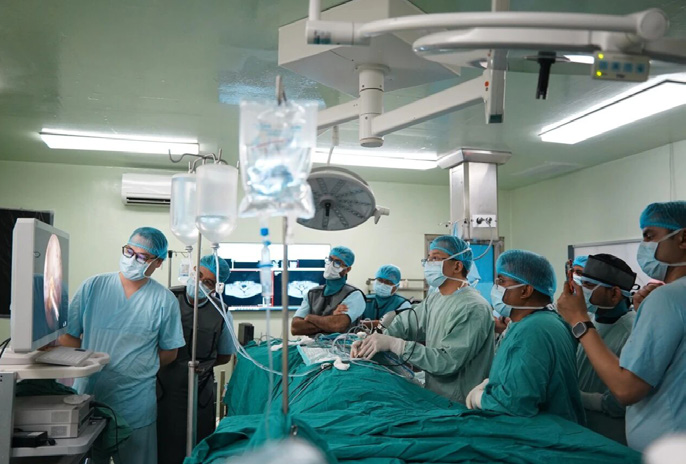
In the operating theatre, HU Qingfeng, Director of Spine Surgery Department at ZJU4H, attending physician Qiu Xiaowen, and Associate Chief Anesthesiologist GUO Jian demonstrated exquisite surgical skills while providing a simultaneous live commentary in English. Both surgeries were performed through two 5-6 mm working portals, eliminating the need for plate fixation and preserving motor function.
The 41-year-old Nepali patient, Sapkota Siva, could hardly contain his excitement after his operation. For nearly three months, he had experienced worsening pain in his right hand and was almost unable to raise it. However, he hesitated to undergo traditional open surgery because of worries like the large incision, long recovery time, and risk of functional impairment. The success of this operation made him the first patient in Nepal to receive minimally invasive cervical spine treatment.
Sapkota Siva was able to get out of bed on the day of the surgery and is expected to be discharged and return to normal life in 2-3 days. “I am the first minimally invasive cervical patient, and I hope to bring confidence and happiness to more Nepalis,” he said, representing local patients’ strong demand for minimally invasive techniques.
In addition, Professor HU Qingfeng performed two lumbar UBE procedures with the preservation of the ligamentum flavum on a 55-year-old female and a 25-year-old male patient who were suffering from lumbar disc herniation symptoms. This technique, innovated by Director Hu’s team, fully preserves the ligamentum flavum and effectively prevents postoperative epidural scar adhesion - a common complication - thereby offering a better option for minimally invasive treatment of spinal diseases.
The operations attracted more than ten spine and neurosurgeons from Nepal and India, including local department leaders and well-known professors, who observed on site. From patient positioning, preoperative localization, and portal puncture to the core operative steps, the team’s standardized demonstrations impressed the attendees and were widely regarded as eye-opening.
During the visit, ZJU4H and the Upendra Devkota Memorial-National Institute of Neurological and Allied Sciences (UDM-NINAS) signed a memorandum of understanding and jointly inaugurated the ZJU4H International Spine Endoscopy Training Center, Nepal Training Base. This is ZJU4H’s first overseas medical technology training base, which was established to promote the development of minimally invasive spinal techniques along the Belt and Road through technology transfer and platform co-building.
Under the agreement, the training base will focus on “technical assistance, joint talent development, and collaborative case research.” It will regularly invite Chinese experts to visit Nepal for surgical teaching and specialized training, while hosting Nepali physicians for advanced study at ZJUFH, facilitating sustained academic exchanges and clinical collaboration between China and Nepal in the field of spine surgery.

In June 2026, Professor He Huang team from the First Affiliated Hospital, Zhejiang University School of Medicine, together with the team of Professor Mohamad Mohty, member of the French Academy of Med...

Why do humans rely on XY chromosomes to determine sex, while birds use ZW — and many reptiles use neither, letting temperature decide instead? Sex determination is remarkably diverse across the animal...
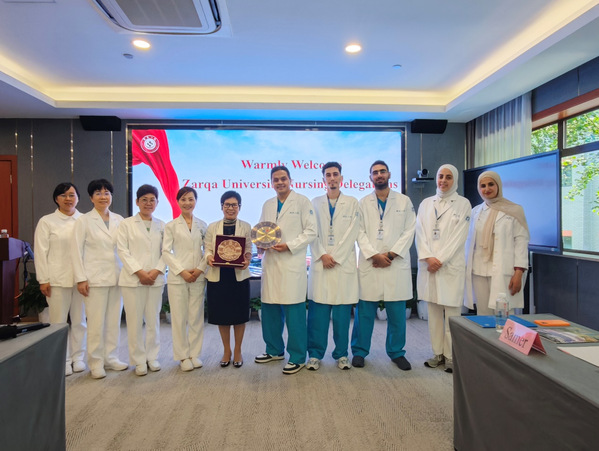
Seven nursing professionals from the University of Jordan and Zarqa University have successfully completed a four-week Hepatobiliary and Pancreatic (HPB) Nursing Workshop at the First Affiliated Hospi...
